

Improving Productivity in Places: what to include in a Local Growth Plan
By Dr Marianne Sensier, on behalf of the Investment in Productive Places Campaign project team
The Government has asked Mayors and Combined Authorities to put Local Growth Plans at the centre of their economic ambitions, giving places more say than ever in how their economies develop. Making the most of that opportunity means confronting a problem that has proved remarkably resistant to policy for decades.
One of the central economic and social challenges facing the UK is why some places find it much harder than others to generate good jobs, attract investment and improve living standards. Here I will provide an overview of our place-based campaign and suggest what the government and metro mayors can do to drive productivity growth and living standards in their regions. As Phase 1 of the campaign now draws to a close, this blog draws on the findings set out in our accompanying summary report. In summary:
- Regional inequalities remain deep and persistent: many communities face lower incomes, poorer health, weaker skills, limited innovation, inadequate infrastructure and the long shadow of deindustrialisation.
- These are not problems that can be solved by one-off projects or narrowly targeted investments. They require a broader understanding of the assets, constraints and opportunities that shape productivity in each place.
- Based on our research findings, we provide some guidance for what places should include in Local Growth Plans.
The Productivity Institute’s Investment in Productive Places Campaign has worked with ten places across the UK to investigate the drivers of local productivity and to support broad-based, long-term, investment-led and evidence-based strategies. Understanding these drivers is crucial for helping places move out of low growth traps and build more resilient, inclusive prosperity. We have developed a community capital assets framework to identify and measure the drivers of productivity within a local economy and to support stakeholders’ conversations within places. Our approach combines qualitative research, including workshops and interviews, with quantitative research, utilising our Local Authority Capitals Dashboard.
Low productivity, weak resilience and overlapping social challenges
Most of the places covered in our campaign experience low productivity levels and weak growth over time, as illustrated by The Productivity Institute Lab’s UK Regional Productivity Growth Tool. These economic challenges are often accompanied by areas of deprivation within each locality, alongside higher rates of child poverty and pronounced health inequalities. This combination matters because weak productivity, poor health and limited opportunity can reinforce one another, making it harder for places to build resilience and move onto a stronger growth path.
There is significant evidence that the challenges facing many of these places have been compounded since the 2008 financial crisis by a succession of shocks. These include austerity reducing the capacity of public services; Brexit disrupting export trade; Covid-19 raising increased ill health and labour market inactivity among parts of the working population; and rising energy prices caused by geopolitical events that have fuelled a cost-of-living crisis. Taken together, these shocks have placed additional pressure on already fragile local economies and made the task of rebuilding productivity and resilience more urgent.
Understanding places through the seven capitals
The capital assets we have discussed with places are physical, human, intangible, financial, institutional, social and natural capital. Together, these capitals provide a practical way to understand the capabilities of a local economy and the foundations on which future productivity growth can be built. A community can strengthen its prospects by strategically increasing its capacity across each of these capitals, rather than treating them as separate or competing priorities. As the assets are interconnected, investment in one capital can trigger positive spillovers across others. For example, better physical infrastructure can improve access to skills and jobs, stronger institutions can unlock finance and collaboration, and investment in natural or cultural assets can support wellbeing, tourism and local identity.
Strengthening these capitals is therefore fundamental to the design and implementation of the Local Growth Plans that the Government has asked Combined Authorities to prepare.
Every place has assets to build on
In the case of the London boroughs (Haringey, Enfield and Waltham Forest), strong labour market growth has seen the expansion of low productivity jobs, often characterised by precarity and poor working conditions, particularly in the foundational and gig economy. This contributed to subdued productivity growth in London since the 2008 financial crisis. More recently, these concerns have prompted the All Party Parliamentary Group for London to launch an inquiry into the capital’s productivity performance since 2008.
Some places struggled to expand opportunities and lacked resilience in the labour market, with employment levels taking a long time to recover from the 2008 financial crisis recession. This has been particularly evident in Rochdale and in Fermanagh and Omagh, where slow employment recovery points to deeper challenges in building more robust and inclusive local economies.
All places included in our campaign also have distinctive strengths in their local economies and communities that can provide a foundation for future growth. For example, Cumberland has strengths in clean energy industries, strong community networks and abundant natural capital. Newport benefits from a strong advanced manufacturing sector and entrepreneurial capacity within its financial capital. South Tyneside and Great Yarmouth both have clean energy specialisations in wind farms, alongside valuable natural capital. South Tyneside and Walsall also have important strengths in advanced manufacturing.

Lessons for policy and practice
Greater collaboration is needed to connect dynamic businesses, public institutions and community organisations in ways that support innovation and expand local opportunity. Building stronger networks and creating opportunities for peer learning can help places share good practice, diffuse new ideas and continuously improve public services. This matters because innovation is not only about frontier firms or new technologies; it is also about strengthening the life chances of the local population. Our findings highlight several key lessons for policy and practice:
- Place-based strategies matter: Policy that does not recognise the distinct characteristics, assets and constraints of each place is unlikely to improve local productivity. The seven-capitals approach helps local leaders tailor investment to a place’s unique assets, making interventions more effective, better targeted and more sustainable over time.
- Narrative and collaboration are critical: A shared story of place builds confidence, attracts investment, and fosters civic pride. Strong institutional and social capital are essential, together with trust, leadership, and horizontal governance helping to align partners around common priorities and sustain action over time.
- Skills and infrastructure drive transformation: Investment in human capital, transport and digital connectivity underpins long-term productivity gains by improving access to jobs, skills and markets. At the same time, cultural and natural assets can be leveraged to support inclusive growth.
- Data-informed decision-making is critical: Monitoring the drivers of productivity, and how they change over time, is crucial for building confidence in local strategies and assessing whether they are making a difference. Combining quantitative metrics with qualitative insights ensures that strategies are grounded in robust evidence, make use of local knowledge and remain responsive to local realities.
- Alignment across governance levels reduces fragmentation: Coordinating local, regional, and national priorities, and using devolution effectively, can reduce policy fragmentation and create clearer routes to improving productivity. Strong alignment helps ensure that investment, skills, infrastructure and innovation policies reinforce one another, rather than pulling in different directions.
A practical guide to developing a Local Growth Plan
The campaign provides useful building blocks with the following practical step-by-step guide to formulating a Local Growth Plan:
- Anchor the Local Growth Plan to the history and the capital assets of the place. Places have evolved over time and their current specialisms are often closely linked to economic, industrial and social history. The introduction to the West Yorkshire Combined Authority Plan provides a useful example of how a growth plan can be grounded in a place’s distinctive trajectory.
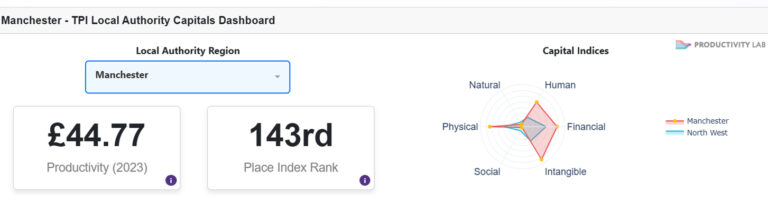
- Assess the strengths and weaknesses of the local economy. This should include industrial, service-sector, community, cultural and natural assets. Strengths and weaknesses can be compared with those of the wider regions using the Local Authority Capitals Dashboard, helping places understand where their capital assets are relatively strong, where they are constrained, and where investment may have the greatest impact.
- Analyse sector specialisation and future growth opportunities. To understand local sector strengths, Combined Authorities should examine employment specialisation across key sectors, including the Government’s eight priority industrial strategy sectors. The Data City has estimated location quotients for these sectors and is developing an open-source platform. Alternatively, employment data from the Business Register Employment Survey on Nomis can be accessed at the 2-digit Standard Industrial Classification level and used to calculate local employment specialisations.
- Develop a scorecard of Key Performance Indicators. Places should identify the most important capital assets to track, using the data that are currently available. The Manchester Economic Strategy, for example, provides a useful illustration of how indicators can be organised and monitored (p. 67). Local areas should also identify gaps in data and explore where data linkages could improve monitoring and evaluation, such as linking administrative local authority data with education, health and wellbeing outcomes. A scorecard should compare local assets with those of the parent region and track change over the short, medium and long-term. These metrics should be updated annually, including when the ONS releases subregional productivity data.
- Engage regularly with local stakeholders. Local Growth Plans should be developed through regular dialogue with stakeholders from business, public services and community organisations. These conversations can help assess progress in the region and identify priorities for Key Performance indicators.
The UK’s persistent regional productivity disparities are not simply economic anomalies; they are structural challenges that weaken national prosperity, resilience and social cohesion. Investing in local economies should therefore be seen not as a cost, but as a catalyst for stronger and more inclusive growth. With the right funding, strategic autonomy and long-term commitment, places across the UK can move from development traps towards virtuous cycles of investment, productivity growth and shared prosperity.
Read the full findings in our summary report which brings together the campaign’s research across all eight places.
Find out more about the Investment in Productive Places Campaign including our Local Authority Capitals Dashboard and place reports.