

Andy Burnham’s move from the Greater Manchester mayoralty to 10 Downing Street raises a specific question: what does the economic record of the city-region he led actually show, and how much of it is transferable to national policy?
This month at The Productivity Institute – an ESRC-funded research consortium – we set out four pieces of research that address that question directly, drawing on evidence about Greater Manchester’s growth trajectory, its record in attracting foreign investment, and the international economic dimensions of any serious domestic growth strategy.
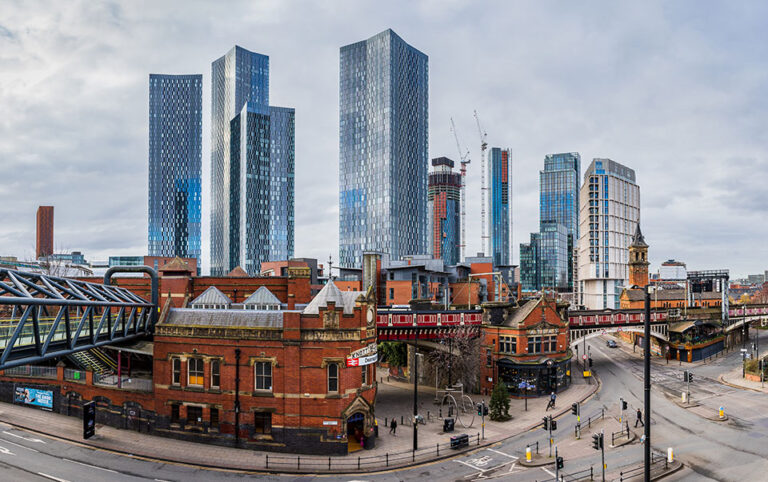
The political moment is unusual. Greater Manchester has had stable leadership and a consistent economic vision for the best part of three decades – a combination that is, by any comparative measure, rare in UK governance. Whether that continuity has produced distinctive economic outcomes, and through which mechanisms, is precisely the kind of question that independent research can help to answer.
These four papers do not offer a verdict on the new Prime Minister or his agenda. They offer an evidence base and reflection from which that agenda can be tested, challenged and refined. TPI research has consistently found that political leadership is a necessary but not sufficient condition for sustained productivity growth: what determines outcomes is whether the institutional architecture, the policy coordination, and the long-term commitment can be built and maintained.
Philip McCann and Raquel Ortega-Argilés
The first paper sets Greater Manchester’s experience within the wider context of UK regional economic performance. The UK has among the highest interregional productivity inequalities of any industrialised economy, a financial system heavily concentrated in and around London, and a land-use planning system that, in their assessment, is effectively plan-less. Against that backdrop, Greater Manchester represents the longest-running mature devolution case in England, and its institutional development — from the 2011 Combined Authority through successive devolution deals to the 2026 integrated settlement — offers evidence about what devolved governance can and cannot achieve. McCann and Ortega-Argilés argue that closing the investment risk premia gaps between London and other UK cities and regions requires not only devolution but structural reforms to finance, planning and public-private coordination that go well beyond any single city-region’s capacity to deliver.
Joe Peck, JP Spencer and Andy Westwood
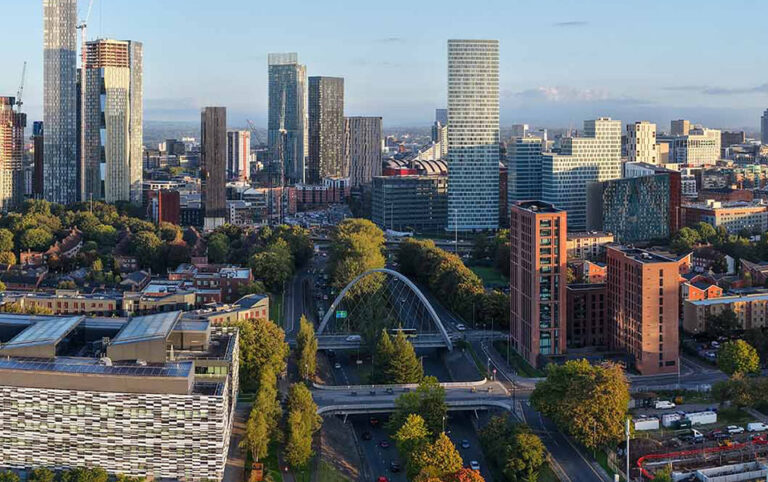
The second paper addresses the contested empirical question directly: is Greater Manchester actually growing significantly, and if so why? The headline productivity figures are strong — Greater Manchester recorded the highest GVA growth and seventh-highest productivity growth of any area at the same spatial level between 2015 and 2023 — but the authors are candid about the measurement challenges. Data revisions, a likely error in the Trafford figures, and a persistent disconnect between productivity growth and earnings growth all warrant caution. Drawing on a broader range of indicators — office-space demand, investment risk premia, skills levels, greenfield FDI — Peck, Spencer and Westwood build a picture that is more mixed than the headline numbers suggest, though still pointing to genuine economic dynamism concentrated in the city core. A second paper examining the mechanisms and transferability of the model follows in September.

Jun Du, Xiaocan Yuan and Diane Coyle
The third paper examines one specific and measurable pillar of Manchester’s performance: its record in attracting foreign direct investment. Using Moody’s Orbis microdata benchmarked against Birmingham, Leeds and London, Du, Yuan and Coyle find that Manchester is decisively the leading non-London destination for greenfield investment, and that what distinguishes the city is not just volume but composition: a markedly higher share of new productive capacity channelled into knowledge-intensive services and R&D, the same sectors associated with its measured productivity growth. The paper also identifies a structural limit. Manchester functions as a delivery-and-research gateway for international investors, not yet a corporate decision hub, and the productivity advantage that defines the city core does not yet extend evenly across the wider city-region.

The fourth piece draws out an implication that runs across all three research papers: that Manchester’s domestic growth model was international all along. The city became the most productive large English city outside London in part because it connected local capabilities, including its universities, its devolved institutions, its skills base, to global capital. Applied at national scale, the same logic points toward an explicit international economic strategy alongside the domestic growth agenda. Drawing on product-level trade data, Du estimates that the UK exports significantly fewer product varieties to EU markets than would have been the case absent Brexit — a structural thinning of supply chains that no tactical adjustment to the bilateral relationship can reverse without a broader strategic framework. The piece argues that the incoming government’s stated priorities — devolution, infrastructure, skills — each have an international dimension whose neglect would materially limit their effectiveness.

These four pieces describe a body of evidence about Greater Manchester’s economic record that is more complex than the current political debate allows. The city-region has produced outcomes that are visible to global capital, measured in the composition and volume of investment it has attracted. The mechanisms that the papers identify as potentially contributing to those outcomes – institutional continuity across administrations, a commercialised university–industry interface, sustained transport investment, deliberate place leadership – are plausible and consistent with the evidence. What the papers do not establish is the causal chain: whether devolution drove the FDI and productivity gains, or whether pre-existing agglomeration advantages attracted both investment and the political case for devolution. That question matters enormously for what other city-regions can expect from similar institutional arrangements.
Three further gaps in the current evidence deserve to be named.
The most immediate is the earnings transmission puzzle: productivity growth in the headline data is not yet showing up proportionally in household earnings across most of Greater Manchester’s local authorities, and resolving whether this reflects measurement problems, distributional dynamics, or structural features of the growth model is essential before welfare claims for the Manchester model can be made with confidence.
The most geographically pressing is diffusion: the core’s productivity advantage does not yet reach the city-region’s outer districts, and it is precisely that challenge – from centre to periphery, from one city-region to others – that national application of the model would face at scale.
The most politically consequential is institutional transferability: Manchester’s performance rested on three decades of cross-boundary collaboration, a specific university-industry configuration, and a political culture that is not easily manufactured. Whether those conditions can be created elsewhere, and at what speed, is the question the new government will need to answer with evidence rather than assertion.
None of this diminishes what Greater Manchester achieved. It defines what must be understood next. TPI’s policy agenda, synthesised in Joining Up Pro-Productivity Policies in the UK (July 2025) across fiscal frameworks, regional policy, skills, trade, FDI, planning and transport, established the analytical foundations and identified where the policy joins are weakest. TPI’s next steps will build on its vast array of research insights, recently summarised in Aligning Resources for Productivity: A Synthesis of TPI Research 2023-2026 (May 2026).
But it also asks harder questions. What does it mean to be a productive economy in a world being restructured faster than policy can track? How do you sustain growth when global value chains are being redrawn by geopolitical competition and trade fragmentation? How do firms and places make investment decisions under uncertainty that is compounding rather than resolving? And can the model that drove growth in the last decade hold as AI reshapes labour markets, as the green transition demands new kinds of capital and capability, and as the health of the workforce moves to the centre of what determines whether productivity gains are real, sustained and widely shared? How do firms adopt and diffuse ideas rather than simply generate them? What determines whether investment flows reach beyond the core to the places and people who need it most? And how do workers and communities build the capabilities to adapt rather than simply endure? This is the research agenda we are building.
We invite researchers, policymakers and funders who see these as the defining questions of this decade to join us and help shape it.