

How can research better inform policy and contribute to real-world change? That question was at the heart of a joint Policy Conference held by The Productivity Institute (TPI) and the Industrial Strategy Advisory Council (ISAC) at Alliance Manchester Business School.
Leaders from government, business and academia came together to explore some of the most pressing challenges facing the UK economy, including place and Industrial Strategy, skills, scaling businesses, investment and technology adoption. Across the discussions, a consistent message emerged: improving productivity will depend on connecting strong evidence with the people, institutions and places able to turn it into action.
ISAC advises the government on topics of importance to the Industrial Strategy including growth, productivity and investment. Its partnership with the University of Manchester, and TPI aims to create a stronger connection between frontier research and the practical policy challenges facing government.
Opening the conference, Dame Clare Barclay, Chair of ISAC, explained that the Council’s focus had shifted from advising government on the development of the Industrial Strategy to providing advice on its effective delivery. She invited participants to share evidence, saying:
“what really is working, what’s not working, how do you monitor and evaluate better, and what would you advise us to push the government harder on?”
John Holden, Vice President for Civic Engagement and Innovation at The University of Manchester, said:
“The point of today is to connect our frontier research with policy development. The range of capabilities we have in this room is amazing, but we all know it is not simply just about producing more research, it is about how we connect that research into policymakers. Today is a really important milestone for the partnership, an opportunity for us all to build relationships, identify the gaps, and learn where our academic expertise can make the greatest contribution to policy development.”
Leonie Lambert, director of the ISAC Secretariat, highlighted the changing policy context and invited attendees to consider how the research agenda should evolve to ensure the Industrial Strategy remains responsive to the country’s needs.
Kalada Bruce-Jaja, Director of Industrial Strategy at the Department for Business, Innovation, Science and Trade, stressed the importance of Number 10 North in terms of the Industrial Strategy, saying:
“There is no doubt that Number 10 North is built on the Industrial Strategy. We massively depend on the expert advice of ISAC and we are always looking to understand what is holding the UK back in terms of productivity, and we’re always in the market for best practice, be that locally or internationally.”
Sam Lister, Director General for Number 10 North, joined the conference for the closing session. He added: “I cannot wait to digest all the thoughts, reflections and findings that have come out of today.” He described Number 10 North as an exciting and important part of the new administration’s agenda, embodying a different model of government. Built around strong relationships and a place-first approach, it seeks to understand the specific challenges facing different communities and ensure government is responsive to their needs.
The first session, chaired by The Rt Hon Greg Clark, ISAC member, explored how a place-based Industrial Strategy could support growth across the UK, with Rebecca Madgin, Arts and Humanities Research Council’s Place Programme Director, distinguishing spatial policy, which targets geographic areas, from genuinely place-based policy which recognises why locations are meaningful to people. Chris Grigg, ISAC member, stressed that devolving funding and powers would only succeed if places also had the institutional capability and connections needed to use them effectively.
Philip McCann, Sir Terry Leahy Chair of Urban and Regional Economics at Alliance Manchester Business School, highlighted the geography of finance, arguing that the cost of capital increases more sharply with distance from London than in comparable countries. He said strengthening regional financial centres could help connect businesses and new technologies with investment in surrounding cities and towns.
The panel reflected on the environment for successful scale-ups. Greg Jackson and Aislinn Rice, ISAC members, drew on their experiences of growing businesses, to highlight the importance of responsive local leadership, access to mentors who have already navigated growth, transport and amenities, and graduate retention. Janine Smith, Executive Director of the GM Business Growth Hub, described the components of a successful scale-up environment, including the connectivity (networks and market access), capability (leadership and access to talent), capital (access to finance) and confidence (identity of a place, and willingness of business leaders to seek advice and growth opportunities).
Nigel Driffield, Professor of International Business at Warwick Business School, argued that successful clusters depend on strong labour markets, transport links and access to skilled workers. While catalysts such as inward investment, entrepreneurship and university spin-outs help clusters emerge, he stressed that government can play an important role through innovation spaces, science parks and business support.
Chaired by Dame Nancy Rothwell, Deputy Chair of ISAC, the session considered skills as a persistent constraint on productivity, highlighting the difficulty businesses face navigating training, concerns about the return on training investment, and the need to distinguish between skills that can be developed quickly and those requiring several years. She called for stronger local partnerships between employers and education providers to ensure provision reflects the capabilities required by the Industrial Strategy’s growth sectors and a clearer “single front door” to help smaller firms navigate training and research collaboration.
Research presented by Adam Saunders, SKOPE Research Fellow at the University of Oxford, suggested that productivity gains may come as much from addressing skills gaps within the existing workforce as from tackling labour shortages. The discussion highlighted the need for better information and coordination between employers, educators and policymakers.
Rosalind Gill, Director of Policy, Analysis and External Affairs at NCUB, highlighted the need for detailed information on workforce challenges, argued that the UK must be clearer about the areas in which it intends to lead and the depth of capability those choices require, and emphasized the need to choose policy levers accordingly.
Chairing the session on business investment, technology adoption and innovation, Keith Anderson, ISAC member, argued that the UK needed to become faster at turning ambition into investment, with delays in planning and infrastructure making it harder for businesses to deliver projects. He emphasised that, while businesses cannot eliminate risk,
“what businesses look for is clarity and stability, not certainty”.
Tera Allas, Senior Advisor for McKinsey & Company, Honorary Professor at Alliance Manchester Business School, described universities as critical to both frontier innovation and the wider capacity of businesses to absorb and apply knowledge. She argued that the UK has strong innovation supply but uneven demand from businesses. Elvira Uyarra, Professor of Innovation Studies, Alliance Manchester Business School, highlighted that the value of innovation assets depends on connections and access. Stephen Roper, Director of the Enterprise Research Centre, suggested that innovation policy needs to be sector-specific, to encourage connections, experimentation and customer-focused innovation.
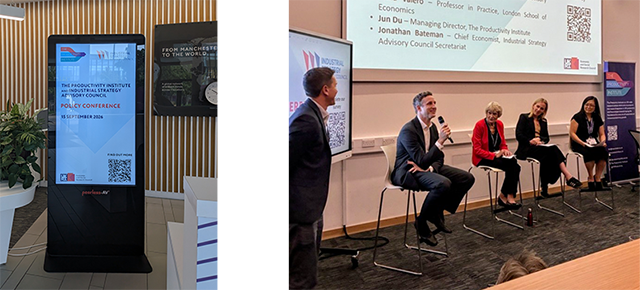
The final session, chaired by Jonathan Bateman, Chief Analyst for the ISAC secretariat, brought together recurring themes from the day.
Dame Nancy Rothwell emphasised the role of connectivity, saying:
“Some things came up numerous times, whether it was skills, devolution or place. But the word that struck me most from today was connectivity – the importance of connecting people, institutions and regions.”
Anna Valero, Professor in Practice at LSE, set out priorities for further research including evidence-based choices about clusters alongside wider access to opportunity, more work on resilience and industrial transitions, continued protection of frontier science, and rigorous evaluation to demonstrate which elements of the strategy should be retained, scaled or changed.
Closing the conference Jun Du, Managing Director of The Productivity Institute, stressed that academics have to make research count and make an impact.
“Often research translation comes too late. Research has to be co-designed, not in terms of how we actually do research, but co-designed in terms of answering the right question. To find those questions we have to invest in building relationships such as we have done today.”
The conference demonstrated the value of bringing together policymakers, researchers and business leaders to tackle shared productivity challenges. Discussions highlighted the importance of translating evidence into policy action through stronger collaboration and partnerships.