

Ten years after the Brexit referendum, the UK’s relationship with the EU has returned to the centre of UK politics. The Prime Minister has said that the options range from the current arrangement to re-joining, and, in his statement to the House of Commons on 12 October 2026, that after the UK–EU summit in Brussels on 20 November the two sides should “set up a serious dialogue about the different options for our relationship in the long term” (Prime Minister’s Office, 2026). This paper provides comparable estimates of what each option would be worth to the UK relative to the Trade and Cooperation Agreement (TCA). It also shows how the answer depends on the 2025 US tariffs and on EU trade policy towards China.
The bottom line. Membership gives the largest gain under every assumption we consider. That gain is 1.08% of real income from lower trade costs in goods, 1.59% with services, and 3.67% in the long run (about £112 billion a year) once modelled productivity and investment effects are added. The partial options are close to one another. Their order depends on how much services access they give, how legally permanent they are, meaning how hard they would be to undo, and how broadly the EU taxes imports from China. The trade-cost results are the best-measured part; the productivity and investment estimates rest on judgements and are best read as ranges.
Table 1: UK gain relative to the TCA, by type of agreement (% of long-run real income)
| Agreement | Lower trade costs, goods only | Lower trade costs, goods and services | With productivity and investment, long run | Same, with US and EU–China tariffs |
| EU membership | +1.08% | +1.59% | +3.67% (£112bn) | +3.24% |
| EEA/Swiss-type agreement | +0.42% | +0.66% | +1.79% (£54bn) | +1.79% |
| Deep free trade agreement (TCA Plus) | +0.50% | +0.74% | +1.54% (£47bn) | +1.55% |
| Customs union | +0.42% | +0.46% | +1.26% (£38bn) | +0.95% |
| Sectoral landing (veterinary agreement and mutual recognition) | +0.28% | +0.30% | +0.85% (£26bn) | +0.86% |
| TCA (the current arrangement) | ||||
| No deal (WTO terms) | −0.70% |
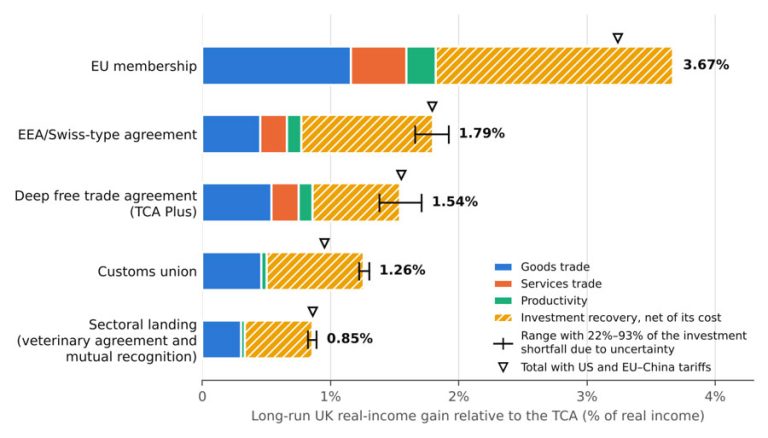
Figure 1: Where the gains come from: long-run UK real-income gain relative to the TCA, by layer (2022 tariff baseline, ψ = 1.99)
Key findings
Lower trade costs alone would raise UK incomes, most of all under membership, which would raise UK goods exports to the EU by about 40%. Productivity and investment could about double the gains, but they rest on a number of key assumptions. For membership, productivity adds 0.32 points and the recovery of business investment 1.85 points net of its cost (Figure 1). This assumes that the 13.6% shortfall in business investment since the referendum persists under the TCA; if it narrowed on its own, membership would be worth 2.92%. Without any investment recovery, membership is worth 1.82% and the other options 0.33 – 0.86%.
Legal permanence matters as well as depth, because agreements that are harder to undo bring back more of the investment held back by uncertainty. This is why the EEA/Swiss-type agreement, which is more permanent than a customs union and also opens services trade, comes out ahead once investment is counted. Its value depends on services access: an EEA-type agreement with full access would be worth 2.34%, a Swiss-type agreement without it 1.25%. A deep free trade agreement has the largest trade effect of the partial options but less permanence, so it comes first only if little of the investment shortfall was due to uncertainty. Of the 5,751 combinations of assumptions we tested, the EEA/Swiss-type agreement ranks first among the partial options in 85% and the deep free trade agreement in the rest; this is a share of the combinations tested, not a probability.
In goods trade a customs union and an EEA/Swiss-type agreement are broadly level. A customs union would fall slightly behind (0.39% against 0.42%) if partners in the UK’s own trade agreements outside the EU withdrew their preferences and the UK reverted to its pre-agreement tariffs. A customs union also obliges the UK to apply the EU’s external tariff. Leaving that aside, if the EU taxed half of its imports from China at the US rate, the customs union would fall about 0.16 percentage points behind, and 0.29 points if it taxed all of them, provided the UK kept its own China policy under the EEA/Swiss route.
The gains take time, and the 2025 US tariffs change little. If the UK re-joined in 2035, output would be 1.5% higher at accession and 2.8% higher by 2040. Net of the cost of the extra investment, which comes first, the gain would be 1.1% by 2040 and about three-quarters of its long-run value by 2050. The government estimates that a veterinary agreement would raise GDP by up to 0.14% in the long-run and linking the emissions trading schemes by 0.1%, close to £9 billion together when scaled to projected GDP in 2040 (Department for Business and Trade, 2025; HM Treasury, 2025). Our sectoral landing is worth 0.28% from lower trade costs, but the packages differ, and the emissions-trading gain is a lower cost of meeting climate targets rather than more trade. Our full gain from membership is of the same order as the Office for Budget Responsibility’s assumption that leaving the EU lowers productivity by 4%, and lies at the lower end of synthetic-control estimates of the cost of Brexit (3.0 – 6.7% of GDP).
What this means for each option
The estimates do not settle which option to choose, which also depends on political judgements the model does not price, but they show what each option is worth and what would make it worth more.
Explore further research and analysis from The Productivity Institute on Brexit, trade, investment and the UK’s relationship with the EU on our Trade and Investment page.
Authors Jun Du, Oleksandr Shepotylo