
Dysfunctional presenteeism across UK regions: Why health related work impairment matters for Wales’s productivity
By Fari Aftab from the Wales Productivity Forum
Workforce health and productivity
Wales’s productivity challenge is often discussed in terms of its comparatively low output per hour and the interconnected factors that may contribute to it, including skills, investment, infrastructure, innovation and business performance. These factors matter. As the Wales Productivity Insights Paper, makes clear, improving productivity will require sustained action across several areas. Workforce health forms part of this wider picture because health and working conditions can influence how effectively people are able to work.
This is why workforce health deserves particular attention. This blog builds on earlier Wales Productivity Forum work examining Wales’s comparatively high sickness absence rate and its implications for productivity. That analysis showed that Wales had the highest sickness absence rate among UK regions in 2022 and continued to record the highest average regional rate in 2023. Sickness absence can reduce labour input through lost working hours and may also disrupt workflows and organisational continuity. It therefore raises wider questions about worker health, job quality and people’s ability to remain in employment.
Yet sickness absence is only one way in which ill health may affect work. Health difficulties may also reduce people’s capacity to perform their jobs even when they remain at work. This is where presenteeism becomes important.
What is dysfunctional presenteeism?
Presenteeism, a term coined by The Productivity Institute’s Sir Cary Cooper, refers to working while experiencing physical or mental health related difficulties that limit how effectively an employee can do their job. In our Welsh Economic Review article, Dysfunctional Presenteeism Across UK Regions, we focus on dysfunctional presenteeism, defined as substantial self-reported health related impairment in work performance. This includes physical limitations, emotional difficulties and bodily pain.
The distinction between absenteeism and presenteeism is important. Absenteeism captures time away from work because of sickness, whereas presenteeism captures reduced work capacity among employees who remain at work. The productivity debate therefore needs to consider not only whether people are employed, but also whether those in work are able to work effectively, safely and sustainably.
What does the analysis show?
Our analysis uses Understanding Society, a large national survey that follows the same people over time. We focus on 37,855 employees aged 16 to 64 between 2010 and 2024. The analysis considers whether physical health, emotional difficulties or bodily pain substantially interfere with work.
The figure compares UK regions after accounting for differences in employees’ personal characteristics, employment circumstances, and physical and mental health. On this adjusted basis, Wales has the highest estimated probability of dysfunctional presenteeism, at 13.0 per cent. The lowest estimate is for the East of England, at 10.6 per cent, creating a gap of 2.4 percentage points.
Figure 1. Fully adjusted predicted probability of dysfunctional presenteeism by UK region.
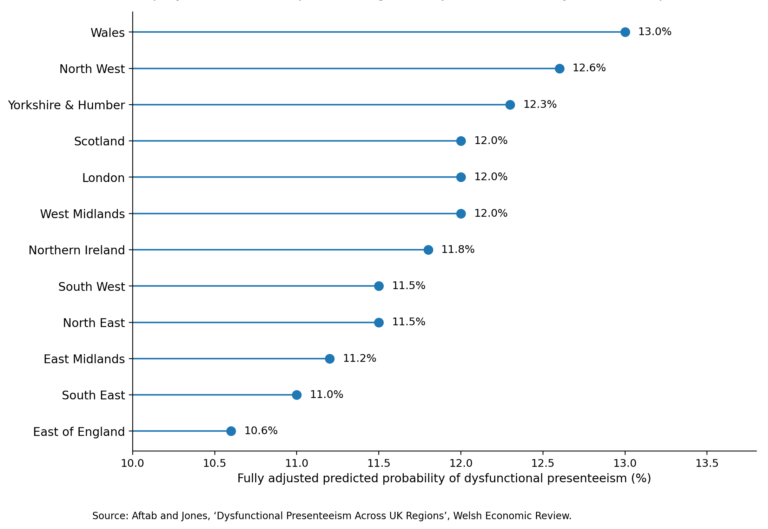
Note: Bars show fully adjusted predicted probabilities of dysfunctional presenteeism. Estimates adjust for survey wave, personal characteristics, employment characteristics, and physical and mental health.
Although these differences are modest in percentage point terms, they are much larger when considered relative to the overall prevalence of dysfunctional presenteeism. For example, the 2.4 percentage point gap between Wales and the East of England is equivalent to approximately one fifth of the sample average. More importantly, measured differences in employees, their jobs, and their physical and mental health do not fully account for Wales’s comparatively higher level. This may indicate that more detailed workplace, organisational or institutional factors influence how health difficulties translate into work impairment. These mechanisms, however, are not directly identified by the analysis.
The findings apply only to employees who remain in work. They should therefore be considered alongside Wales’s wider challenge of economic inactivity related to ill health. The analysis does not show that Wales has a larger proportion of people with reduced work capacity across the whole working age population.
Why pain related work impairment matters
Of the health components examined, pain interference displays the clearest differences between Wales and other UK regions. This matters because pain at work is not simply a personal health issue. Its effect on work may also depend on job design, workload, flexibility, occupational health support, line management and workplace adjustments.
A worker experiencing pain may still be able to work effectively where tasks can be adapted and appropriate support is available. Where such support is limited, the same health condition may be associated with greater work impairment. Presenteeism should therefore not be treated only as an individual health problem. It reflects the interaction between health and the conditions under which work is performed.
Taken together, the evidence on sickness absence and presenteeism highlights two ways in which ill health may affect productive capacity. The first is lost labour input when employees are absent from work. The second is reduced capacity when employees remain at work but experience health related impairment. Focusing only on sickness absence therefore overlooks an important part of the relationship between workforce health and productivity.
Implications for employers and policy
The findings indicate that productivity analysis should pay greater attention to workforce health and the quality of work. Employers should consider whether employees have realistic opportunities to adjust tasks, manage pain, access appropriate support, recover when unwell and maintain performance without worsening their health. This includes effective line management, occupational health provision, appropriate flexibility, workload management, autonomy and workplace adjustments.
This does not mean encouraging employees to remain at work when sickness absence is appropriate. The aim should be to create conditions in which employees can recover when necessary and work safely and effectively when continued employment is manageable. Policymakers should view workforce health as part of the wider productivity agenda, alongside investment, skills, infrastructure and business performance.
Read the full analysis
Read the full analysis in our Welsh Economic Review article, Dysfunctional Presenteeism Across UK Regions.