

View the conference programme (PDF)
Registration is now closed and the conference is fully booked.
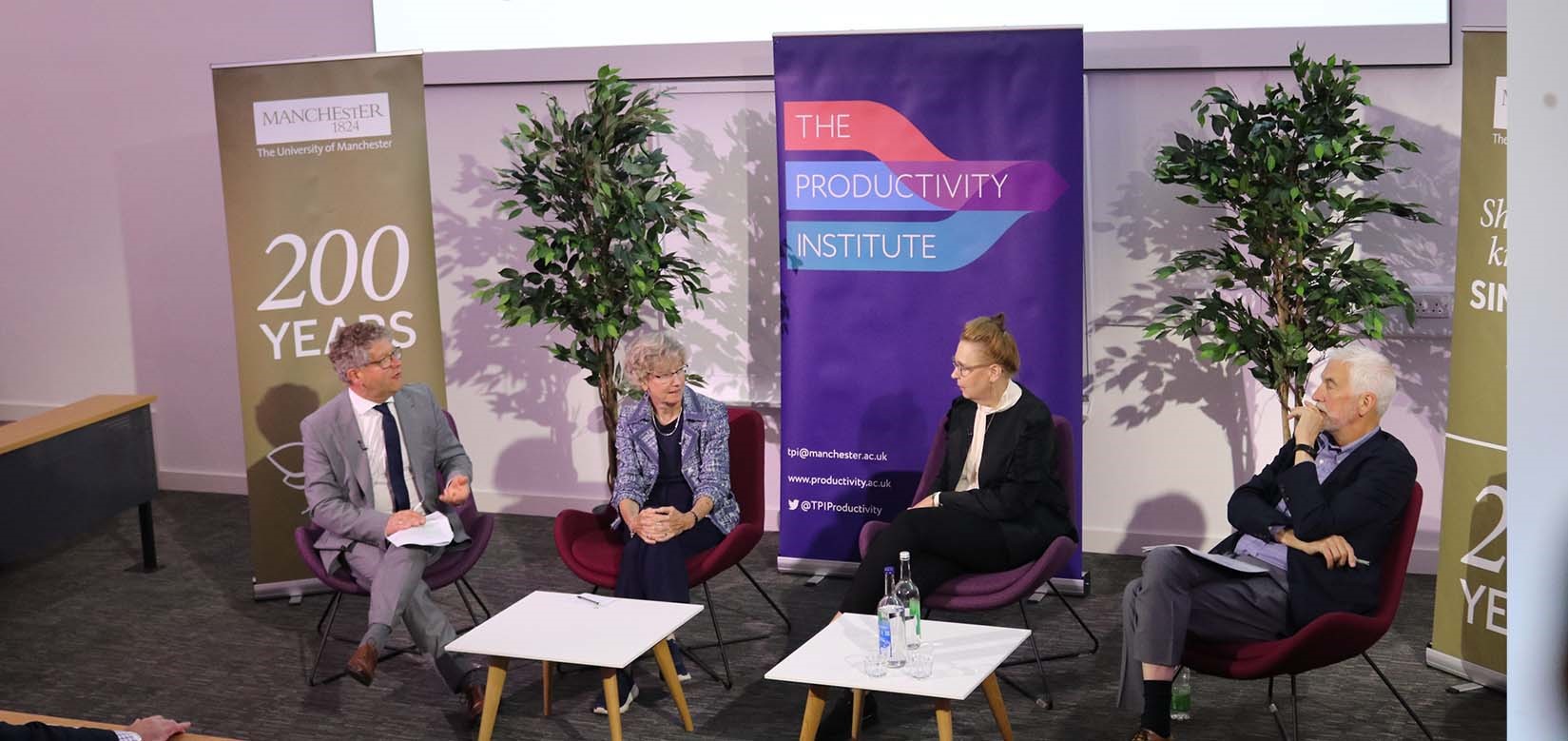
Building on the success of last year’s event, this year’s conference brings together leading productivity researchers to take stock of the evidence base and explore frontier questions for the next wave of research. Thematic sessions cover trade and global value chains, investment, place, workforce skills, and innovation.
The event is free to attend and welcomes both specialists and those with a broader interest in how productivity impacts work, growth and well-being.
François Lafond from the Institute for New Economic Thinking at the University of Oxford will provide the keynote address. François’ main areas of research cover the economics of innovation and productivity, environmental economics, complex systems, and forecasting.
Registration is now open through Eventbrite.
Be part of the conversation shaping how we understand and improve productivity in a changing world.
Please note: While every effort will be made to maintain the programme once it is published, it is subject to change. We recommend allowing flexibility in your travel plans.
 What to Expect
The UK faces a renewed productivity challenge shaped by global uncertainty, technological change and persistent regional inequalities. Bringing together leading researchers, policymakers and practitioners, this conference will explore the key drivers of productivity growth and the policy choices needed to strengthen the UK economy. Across five themed sessions, speakers will examine the changing landscape of trade and services, the role of domestic and foreign investment, the importance of place-based growth, the future of workforce skills, and the relationship between innovation and firm performance.
Attendees can expect evidence-led discussions on some of the most pressing economic questions facing the UK today. From the implications of post-Brexit trade reorientation and geo-economic fragmentation to the opportunities and challenges presented by artificial intelligence, ageing populations and regional growth strategies, the conference will provide fresh insights into the factors shaping productivity outcomes. The day will conclude with a forward-looking panel on the future of productivity research, exploring the questions that should guide the next generation of evidence and policy development.
Alliance Manchester Business School, Booth St West, Manchester, M15 6PB
14 September 2026
Contact us: theproductivityinstitute@manchester.ac.uk
Stay connected by following The Productivity Institute on social media:
LinkedIn | Bluesky
This year’s event will take place from 9:30 AM – 5 PM on 14 September 2026 at Alliance Manchester Business School.
View the conference programme (PDF)
Time |
Session |
| 09:30–10:00 |
Arrival and registration |
| 10:00–11:00 |
Conference opening |
| 11:00–11:20 |
Break |
| 11:20–12:20 |
Session 1a: Trade, services and productivityHow is the UK repositioning itself within shifting global value chains? This session explores the implications of geoeconomic fragmentation and post-Brexit trade reorientation for UK exports of goods and services, and what these structural changes mean for firm-level productivity and competitiveness. |
| 11:20–12:20 |
Session 1b: PlaceRegional disparities remain one of the UK’s most persistent economic challenges. This session examines the geography of productivity, asking what place-based industrial strategy can realistically achieve and what conditions are needed for local economies to thrive. |
| 12:20–13:20 |
Lunch |
| 13:20–14:20 |
Session 2a: Workforce skillsFrom AI adoption to an ageing workforce, the demand for skills is changing fast. This session examines what firms need, where the current system is falling short, and how policy can better support workers and employers through the transition. |
| 13:20–14:20 |
Session 2b: Innovation and growthInnovation is a means to an end – enhanced value creation through productivity improvement and growth. This session focuses on the links between innovation and firm performance, and how policy can better support the effective exploitation of new ideas. |
| 14:20–14:40 |
Break |
| 14:40–15:40 |
Session 3a: InvestmentCan domestic and foreign investment – guided by the Industrial Strategy and regional growth strategies – deliver the productivity gains the UK needs? This session examines the evidence and explores what more effective investment policy might look like. |
| 14:40–15:40 |
Session 3b: AI and the economyArtificial intelligence is moving from experimentation into deployment across the economy. This session examines the early evidence on AI adoption and its effects on productivity, work and firm performance, and asks what data and methods researchers need to track an economy being reshaped in real time. |
| 15:40–16:00 |
Break |
| 16:00–17:00 |
Closing panel: future directions for productivity researchWhat are the outstanding questions for UK productivity research, and what should the field prioritise next? |
| 18:00 |
Conference dinner |
For thirty years, productivity research treated global integration as the given and slow growth as the puzzle. Neither assumption survives contact with today’s economy. Trade is being reconfigured, investment is hesitating under uncertainty, technologies are diffusing unevenly across firms and places, and the data we built our evidence base on are straining to keep up.
This year’s event brings together leading productivity researchers through a combination of invited presentations and an open call for papers. We invite papers that ask the next questions, across five themes:
We particularly welcome work using new data, methods and theories, and submissions from early-career researchers. Selected papers will be presented within the thematic sessions, alongside the UK’s leading productivity researchers.
Send a draft paper or extended abstract to theproductivityinstitute@manchester.ac.uk by 31 July 2026. Submissions will be reviewed by the organising committee and decisions will be sent by 7 August 2026.
Travel expenses for presenting authors will be covered and presenting authors are also invited to a closed invitation policy conference on Tuesday 15 September, hosted in collaboration with the Industrial Strategy Advisory Council.
The future of the economy will be argued from productivity research and evidence built now. Bring yours to Manchester.
For further information, please contact theproductivityinstitute@manchester.ac.uk
Please take extra care of any unsolicited travel related emails from third-party companies. These are not affiliated with The University of Manchester or the organisers of the conference. If you receive such emails, please ignore them and do not share any personal information.
There are several hotels close to Alliance Manchester Business School.
The Hyatt Regency and Hyatt House hotel is a five minute walk away, on the Alliance Manchester Business School campus. It offers preferential rates for attendees of events at The University of Manchester.
Hyatt Regency
You can book your room on the Hyatt Regency website:
If you want to book a room for 15 people or more, you can email hotel@manchester.ac.uk.
Bookings are advance purchase only and subject to availability. You won’t be able to change your booking once it’s confirmed.
Hyatt House
To book a reservation at Hyatt House you can either:
How to get to Alliance Manchester Business School
The conference will be held at Alliance Manchester Business School, which can easily be accessed by private and public transport via car, rail, air and on foot.
By rail:
The University of Manchester is located on the south side of Manchester city centre and is 1.5 miles from Manchester Piccadilly railway station and less than 1 mile from Manchester Oxford Rd railway station. Piccadilly is the main inter-city and cross-country hub.
There is a taxi rank outside the front and rear entrances to Manchester Piccadilly (the rear entrance is slightly nearer to the university campus).
By car:
For SatNav please use the postcode M15 6PB.
There is parking nearby at The University of Manchester (Car Park D), Booth Street West, Manchester, M15 6PB or NCP – Manchester Aquatic Centre, Booth Street East, Manchester, M13 9SS. Charges apply.
Please be aware of overnight charges or overnight parking restrictions.
Walking:
Manchester is an easy-to-walk city. You can get to Alliance Manchester Business School by walking from Manchester Oxford Road station, which takes approximately 15 minutes and from Manchester Piccadilly station, which takes approximately 20 mins.
By air:
The University of Manchester campus is located 10 miles from Manchester International Airport.
Trains run frequently from the airport station into Manchester Piccadilly station, or a taxi from the airport to the university will cost approximately £25.
Journey planning
More than 5.6 million journeys are made across Greater Manchester’s transport network each day. Visit the Transport for Greater Manchester’s website to plan your journeys in and around Manchester, especially is if you using public transport.
Interactive campus maps
You can find your way around our campus using our interactive maps.
PDF campus maps
You can also download our maps in PDF format:
Our campus map shows the wheelchair-accessible route around the University. Please note that the published route does not cover all areas of the campus due to ongoing/planned construction works. The route is likely to be modified as and when areas of the campus are redeveloped.
There is also an accessibility map for the University on the AccessAble website. It includes access guides for each building, including University Place.