This report summarises the research findings from three inter-related groups of people research projects. The first group examines skill demands and supplies, and how they vary by region and country. The second examines how skills are changing with digital and AI technologies from an organisational, innovation and industry perspective. The third group of projects interrogates how characteristics of job design and people management practices, including how worker engagement and working from home, shape productivity and inequalities.
The primary objective of this research was to determine how do workers and organisations develop the skills, job design and engagement necessary to ensure productivity gains in the digital era? The research employed an inter-disciplinary perspective with contributions from economics, social and work psychology, management and innovation studies, HRM and employment relations.
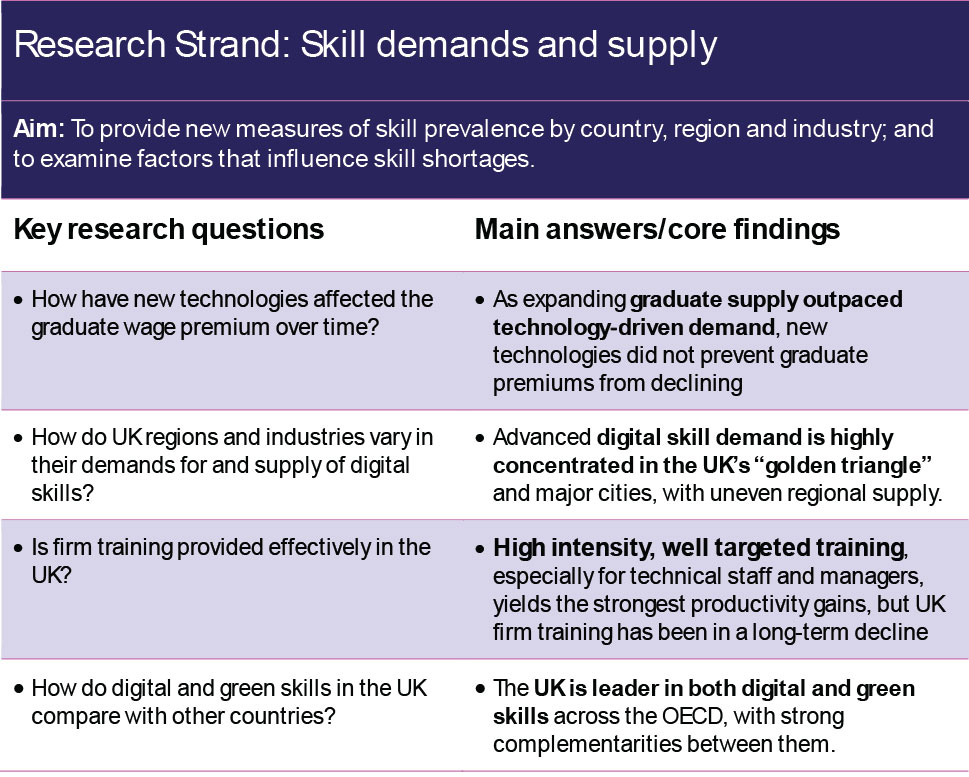
The main findings from the skill demands and supplies research were:
In the digital era, technologies continue to be biased in the direction of demanding high skilled labour, but the reliance on university graduates to measure high skills is less salient than in previous eras.
There are large regional variations in the extent to which firms demand advanced digital technical skills and to which formal education supplies the STEM skills required, with London and parts of the South, including Cambridge, dominating. These variations do not just reflect industry compositions.
Digital and Green skills are highly correlated across occupations. Most UK industries exhibit greater digital and green skill intensity than their European, mostly driven by its greater share of knowledge intensive services industries.
The quality rather than the quantity of firm provided training is crucial for generating productivity improvements and it is important that both managers and workers acquire this training.
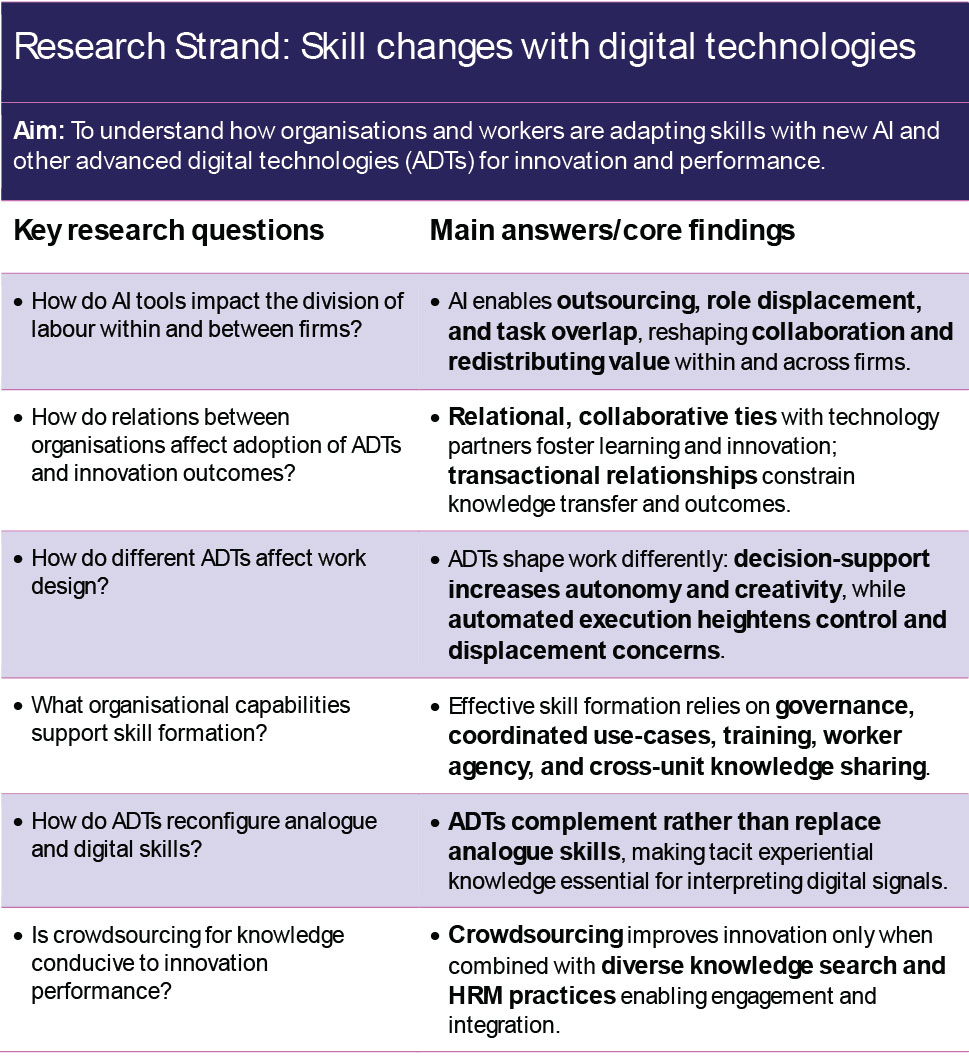
The main findings from skill changes with digital technologies work strand were:
Skills are changing with AI and digital technologies in a variety of ways, far beyond a narrow focus on AI and digital skills, that reflect organisational, industry and institutional context and diverse skill outcomes.
In sectors with a high degree of collaborative work (e.g. creative sectors), AI technologies are reducing interdependencies between job roles and speeding up workflow with mixed outcomes for employment prospects.
In public service, purpose-driven organisations (like the BBC), an effective organisational innovation strategy (with sustained resources, deep cross-functional capabilities and clear end-to-end ownership) can support the bridging and scaling of required skills with implementation of generative AI technologies.
Skills required for digital transformation in core sectors of agriculture and manufacturing extend beyond technical proficiency to include: supply chain capabilities; strategic planning; and interrogative capabilities.
Patterns of skill change (and organisational performance) with AI implementation are closely related to features of job design, particularly whether humans or AI set task rules and/or execute the task actions.
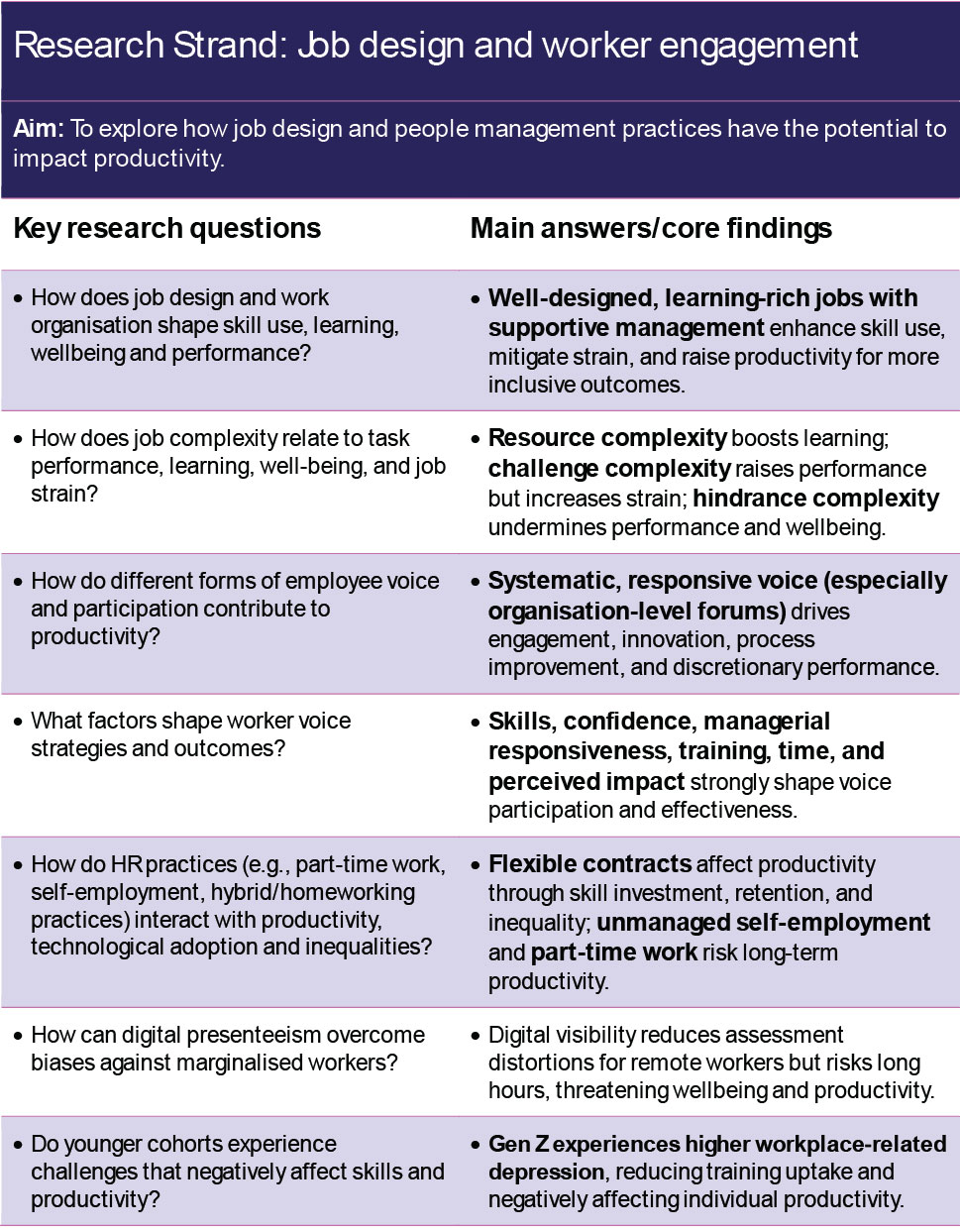
The main findings from the job design and worker engagement work strand were:
Understanding job design and different forms of task complexity is important to learning and wellbeing within organisations.
Non-standard and broader ‘low road’ employment practices than conceive human capital as a cost rather than ‘input’ may hold immediate benefits to employers but present risks to longer term skills development, technological adoption and productivity growth.
The rise in self-employment and outsourcing within more Knowledge Intensive services raises questions regarding potential impacts on longer term human resource development sustainability where human capital needs are sourced externally rather than developed in-house.
A climate of psychological safety is essential to effective employee voice to fully harness the productive potential of the workforce, while there is a need to more fully articulate the management case for increasing employee voice.
A common idea that emerges from all three strands is the notion of ‘alignment’, whether it is matching digital skills to available supply, aligning training of workers and managers, organisations needing to align practices that engage workers with changes in innovation, strategy and human resource management practices.
The main policy conclusions are as follows:
To promote revisions to education curricula to better prepare students for changes in the labour market brought about by technological changes. This may require more joined up provision of education at all levels, school, FE colleges and Universities, increased funding and more coherent skills policies at national and regional levels.
The need to provide incentives for firms to invest in more high-quality training and provide information to small and medium sized enterprises on opportunities for training, especially online offerings.
Develop a clear sector-focused approach to skill change by aligning with industrial policy and employment strategies for different sectors.
Incentivise organisations to commit resources and design new activities for cultivating the required relational and organisational capabilities to enable them to implement, adapt and derive value from AI and digital technologies.
Support management efforts to bridge knowledge and technology gaps with specialist AI and digital suppliers – including joint team problem-design and problem-solving, inhouse training, and new inter-firm methods to diagnose problems and improve collaborative relationships.
Productivity strategies should explicitly recognise job design, learning opportunities and worker wellbeing as foundations of sustained performance.
TPI research calls for the introduction of policies such as a right to disconnect to protect workers, especially homeworkers and disadvantaged groups.
Expanding access to higher quality flexible and part time work is important to reducing gendered and life-course inequalities in productive participation.
Authors Damian Grimshaw, Mary O’Mahony and Anthony Rafferty