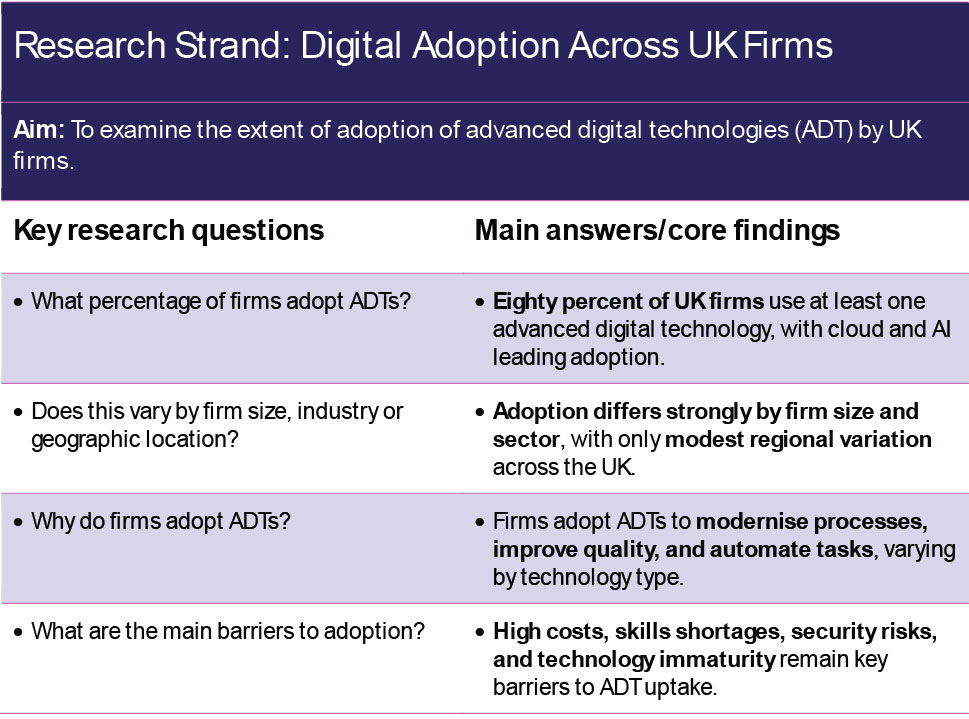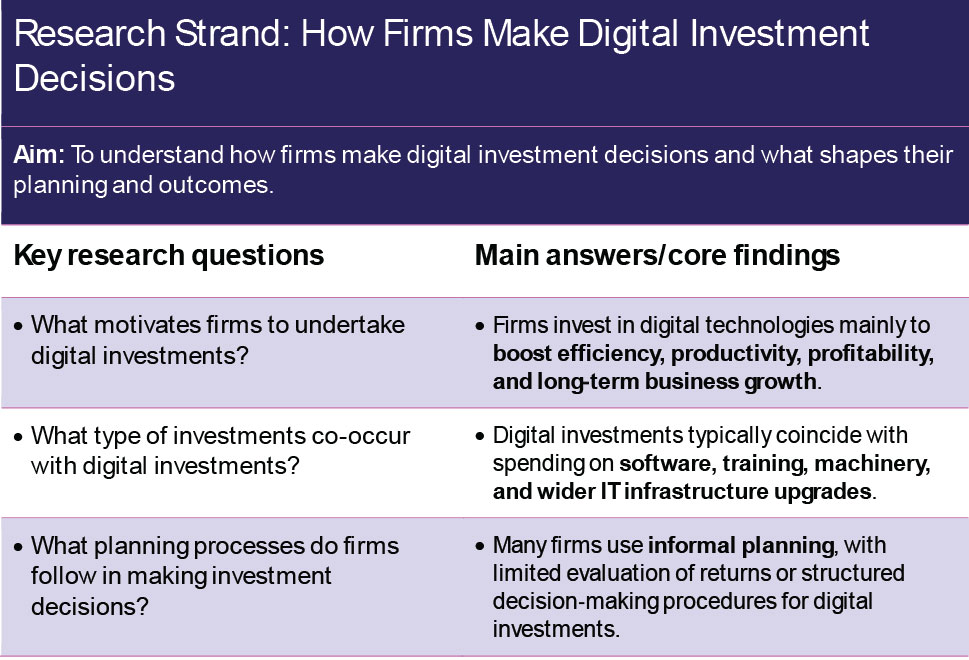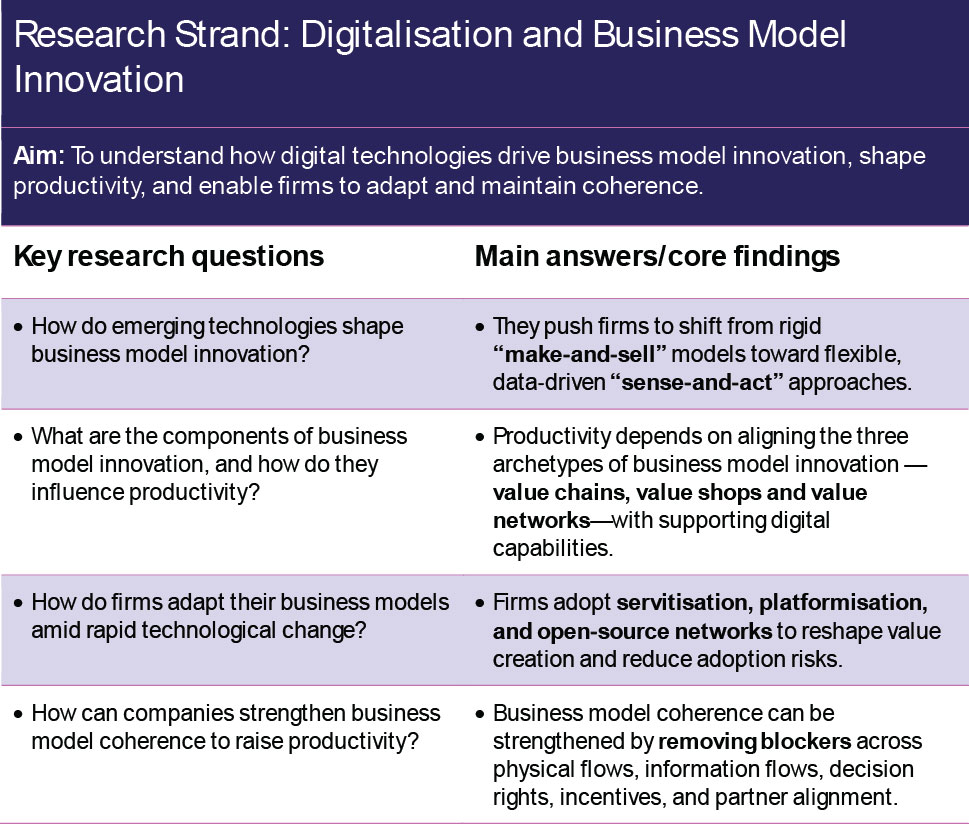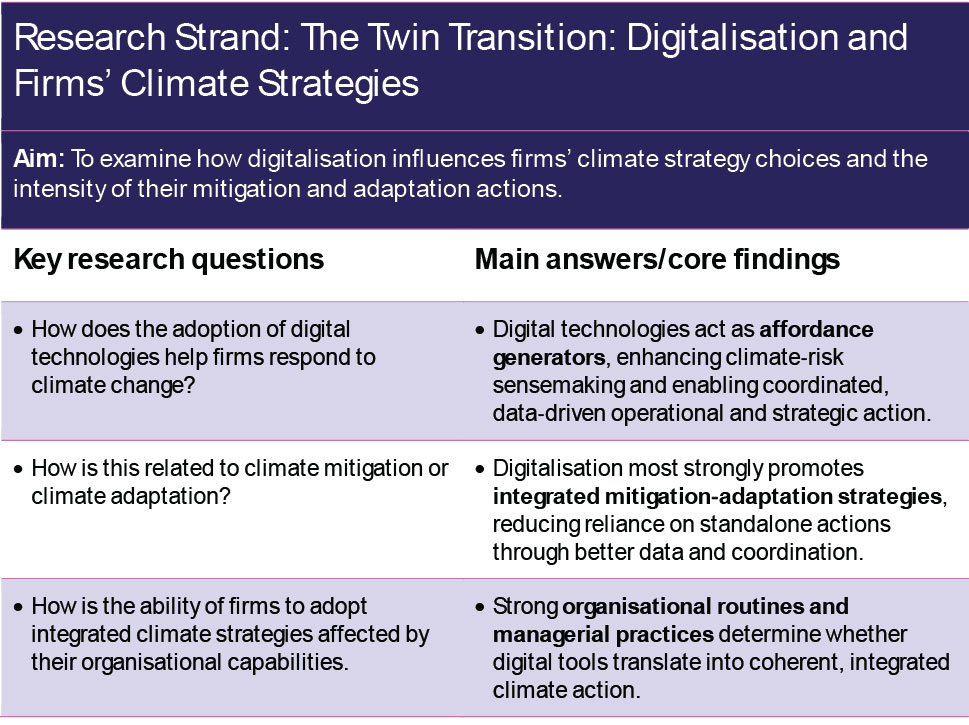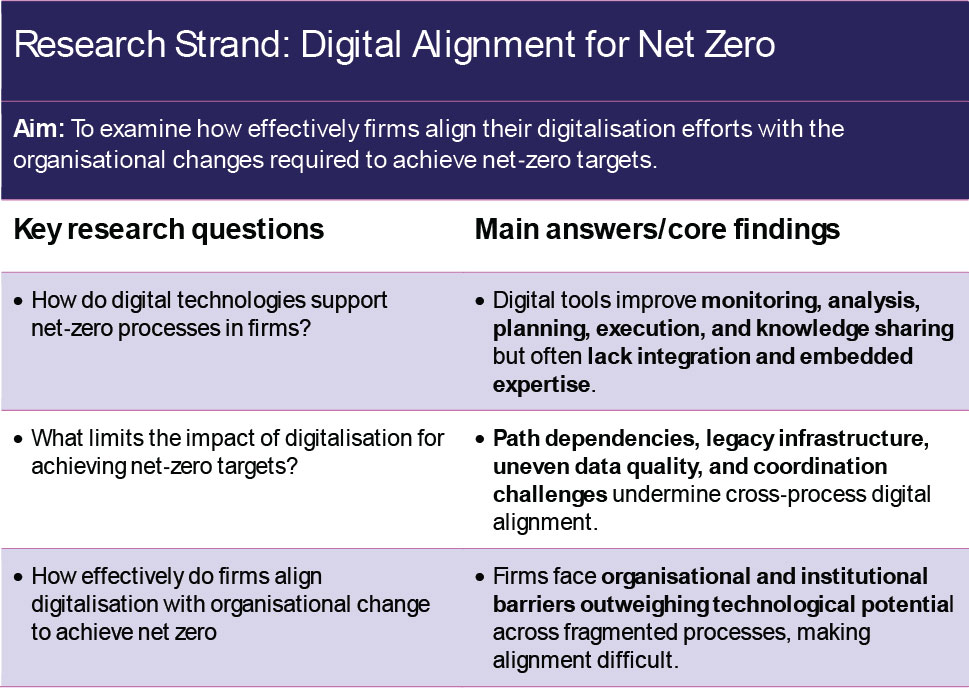

This report synthesises five major research projects supported by The Productivity Institute (TPI), examining how digital adoption, business model innovation, climate strategy, investment decision-making, and organisational alignment influence the productivity and sustainability performance of firms. Using diverse methods – including UK-wide surveys, large international datasets, and in-depth qualitative research – the evidence delivers a clear message: digitalisation offers substantial performance benefits, but only when complemented by additional investments, organisational coherence, and strategic alignment. Adoption alone is rarely sufficient. Across all studies, three themes recur:
1 – Adoption is necessary but not sufficient – firms frequently adopt technologies without realising productivity gains because complementary assets – skills, organisational redesign, interoperable systems – are underdeveloped.
2 – The biggest gains come from alignment – alignment is required at multiple levels, within firms (business models, processes, incentives, decision rights), across organisational functions (monitoring–analysis–planning–execution–knowledge sharing) and across supply chains (technology parity, data standards),
3 – Policy should support both adoption and alignment – this is likely to involve support measures which can
Digital technologies offer significant new opportunities for productivity, innovation, and climate resilience. However, the UK’s challenge is not in adopting technologies but in aligning efforts. Achieving the “bits to benefits” pathway requires coordinated investment in skills, organisational redesign, strategic planning, and interoperable infrastructure. Policy should therefore focus not only on helping firms adopt technologies but also on enabling them to use these innovations effectively, coherently, and productively.
Authors Stephen Roper and Chander Velu