

Manchester, the Manchester Model and Inclusive Growth
Manchester is regarded as one of the UK’s leading examples of place-based economic development, but what can the ‘Manchester Model’ teach us about improving productivity, attracting investment and delivering inclusive growth across the country?
This was the subject of a special debate chaired by TPI Managing Director Professor Jun Du that brought together leading academics, economists, policy specialists and regional stakeholders at Alliance Manchester Business School (AMBS) as part of their Vital Topics Global event series.
Journey
The evening began with a presentation from Professor Philip McCann, Sir Terry Leahy Chair in Urban and Regional Economics at AMBS, who reflected on Manchester as a ‘turnaround city’ and the key milestones during its regeneration journey since the early 1990s.
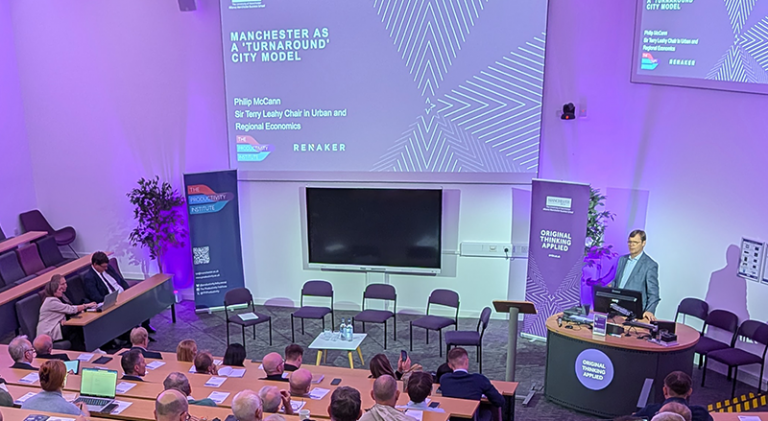
As he reflected: “The start of the process that got Manchester to where we are today started in the early 1990s when people like then city council Chief Executive Sir Howard Bernstein realised that on so many levels the city was on its own, no-one was helping it. The city had been going backwards as had many cities across the UK because of industrialisation shocks. The visionary leadership of people like Sir Howard was that ‘we don’t have a future unless we change how everything works and how we do things’.”
Levelling up
Fast forward to more recent times and Professor McCann said the 2022 Levelling Up the UK White Paper was a particular landmark. “That really moved the whole discussion forward and therefore the political narrative and therefore the opportunities.”
Meanwhile he said the drive towards devolution was becoming ever more pressing. “The reason is that the UK has a fundamental governance failure at its heart. The UK public sense value of central government is ranked 34th in the OECD. Yet at the same time we are almost the most centralised state in the OECD. If we have such low public confidence in the centre of the state, and the centre of the state is tasked with doing almost everything, what you have got is an enormous governance failure. Manchester realised it had to find a way out of this centralisation, break the mould and find ways to do things differently.”
Turnaround cities
Professor McCann stressed that Manchester was not alone as a turnaround city. His own research with other universities had shown that one of the key lessons that comes out of cities that have been turned around is that there is always clear complementarity between the urban development strategies and economic development strategies.
“Strategies for growth and development also have to be comprehensive. So much in the UK has been piecemeal and ad hoc. But you need to go big and go long, and build a strategy which is integrated.”
Panellist Henri Murison, CEO of The Northern Powerhouse Partnership, said his reflection on the topic was a relatively simple one. “Lots of things matter in economics, but in the end productivity is the thing that matters the most. If you look at the journey that Greater Manchester has been on, understanding the fundamental drivers of economic performance has been at the centre of this project from the very beginning. What is very noticeable about Manchester’s journey has been the willingness to be very specific about what needed to be done and to make difficult political trade-offs.”
Lessons for rest of UK
Fellow panellist Melanie Jones, Professor of Economics at Cardiff Business School and Academic Lead on the Wales Productivity Forum, said there has been a real shift towards thinking about how the Manchester model might be translated across the country. “Manchester has some very unique features. For instance, we have heard this evening about how long the economic strategy had been developing in this area and some of the very important fundamentals that helped Manchester achieve what it has. There are lots of good lessons we can learn from the Manchester experience, particularly around consistency, long term vision and co-ordination.”
And Nigel Driffield, Professor of International Business at Warwick Business School and Academic Joint Lead on the Midlands Productivity Forum, added: “What Manchester has done well is business support in terms of helping supply chains – which don’t recognise regional boundaries – to grow, alongside support for innovation, support for skills. And all of that sits under the region having an honest conversation with itself and with inward investors about what it can do.”
Read more about TPI’s research on ‘Manchesterism’ on our dedicated Manchester Model webpage. You can watch the full recording of the Vital Topics Global lecture on Alliance Manchester Business School’s YouTube page.