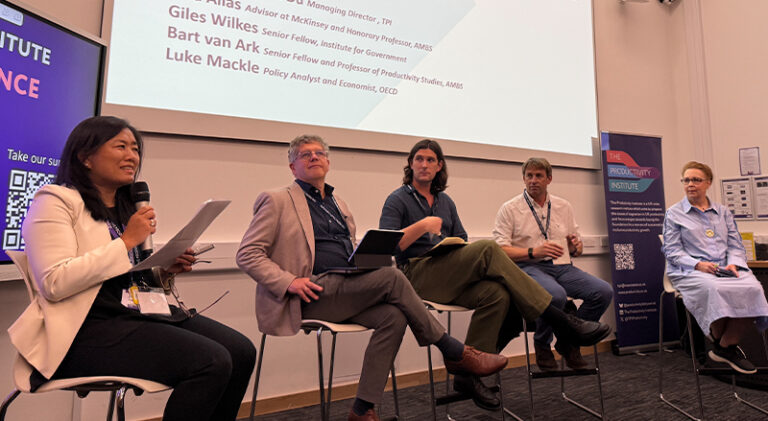

The Productivity Institute’s Academic Conference brought together researchers and experts to examine some of the most important questions shaping the UK’s productivity future. Under the theme ‘Productive Futures: new questions for a changing economy’, the day showcased the latest research from across the UK, with discussions spanning trade, place, workforce skills, innovation, investment and artificial intelligence.
The conference was opened by Jun Du, Managing Director of The Productivity Institute, followed by a keynote address from François Lafond on technological progress, technology diffusion and productivity. His presentation explored how changes in the cost and adoption of technologies can help us understand and forecast their wider effects on productivity.
Delegates then moved into six breakout sessions covering trade, services and productivity; place; workforce skills; innovation and growth; investment; and AI and the economy. Here we outline some of the key messages from the six sessions held, and questions for future research.
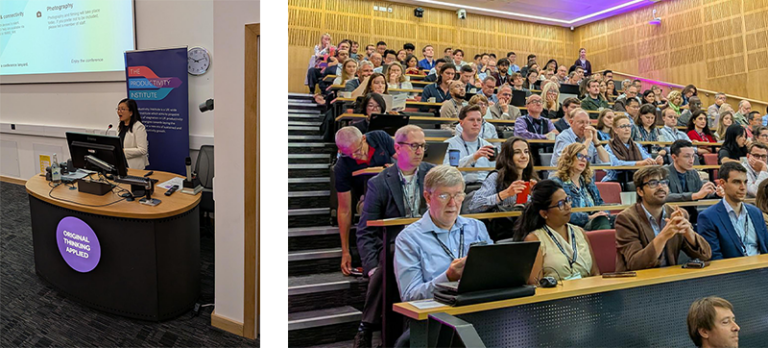
This session positioned trade as central to the productivity debate, not as a separate sectoral issue but as a key channel through which firms access scale, competition, inputs, knowledge, customers and innovation opportunities.
The opening remarks highlighted that the UK’s long-standing productivity challenge predates Brexit, but that Brexit and the Trade and Cooperation Agreement (TCA) provide an important setting for observing how firms respond to new trade frictions.
Across the three papers presented, a consistent theme emerged: aggregate trade effects mask substantial variation beneath the surface, with outcomes depending on firm size, supply-chain depth, product characteristics, exposure to services, and financial resilience.
This session explored the geography of productivity, examining what place-based industrial strategy can realistically achieve and what conditions are needed for local economies to thrive.
It positioned regional productivity as the outcome of several interacting systems including the health and skills of workers, the geography of labour markets, public investment in digital innovation, and the movement of people and knowledge across places.
A consistent theme was that productivity cannot be understood solely within fixed administrative boundaries. Commuting flows, labour mobility, inter-regional connectivity and innovation clusters all shape how benefits and constraints travel across places.
From AI adoption to an ageing workforce, the demand for skills is changing fast. This session examined what firms need, where the current system is falling short, and how policy can better support workers and employers through the transition.
The session connected productivity growth to the movement and development of people, skills and knowledge. The presentations showed that productivity gains may come from improving the proficiency of existing workers, widening access to specialised talent, and enabling knowledge to travel across occupational, organisational and national boundaries.
At the same time, the discussion stressed that these gains are not automatic. A consistent message was that policy needs to consider both aggregate productivity gains and how benefits, costs and decision-making power are distributed.
This session explored the role of innovation, public support, collaboration and transport connectivity in shaping productivity and growth. It considered why innovation activity matters for firm performance, how repeated innovation grants affect firms beyond the first award, and whether transport reliability influences the success of collaborative research projects.
It positioned innovation as a central driver of productivity and growth, while also highlighting a puzzle in the UK evidence base. Although the UK performs strongly in international innovation rankings and provides substantial public support for R&D and innovation, the proportion of innovation-active firms appears to have fallen across many sectors since the mid-2010s.
The opening discussion stressed that innovation support matters, but that the design, targeting and sequencing of that support are critical.
Can domestic and foreign investment, guided by the Industrial Strategy and regional growth strategies, deliver the productivity gains the UK needs? This session examined the evidence and explored what more effective investment policy might look like.
A central theme was that the productivity effects of investment depend not only on the amount invested, but also on the timing and allocation of resources, the characteristics of firms and places, and the policy institutions that connect investment with skills, business support and infrastructure.
The discussion highlighted the complexity of coordinating inward investment, skills, business support and transport across institutions and geographical levels. Devolved administrations may be better positioned to align these functions within a single jurisdiction, while England faces a more fragmented policy landscape.
This session examined how rapidly artificial intelligence is spreading across firms, why adoption remains uneven, and how boards, management practices, organisational design and firm resources shape whether AI supports efficiency, productivity and more exploratory innovation.
It brought together international survey evidence and three firm-level studies to explore both the pace and the character of AI adoption. The opening evidence showed that reported use is already widespread and rising quickly, but that realised employment and productivity effects remain modest compared with firms’ expectations for the next few years.
The central message was that AI is not a stand-alone technology: its value depends on complementary capabilities in governance, management, data, skills and organisational coordination. Adoption is also highly uneven, with larger, more productive and better-resourced firms generally better placed to invest, experiment and capture returns.
Across the six sessions, a clear message emerged: improving productivity will require a better understanding of how firms, workers, technologies and places respond to change. The discussions highlighted both the depth of research already under way and the important questions that remain. By bringing together different perspectives and areas of expertise, the conference provided an opportunity to share emerging evidence, challenge assumptions and help shape the next phase of productivity research.